Custom website vs website builder: which one does your small business need?
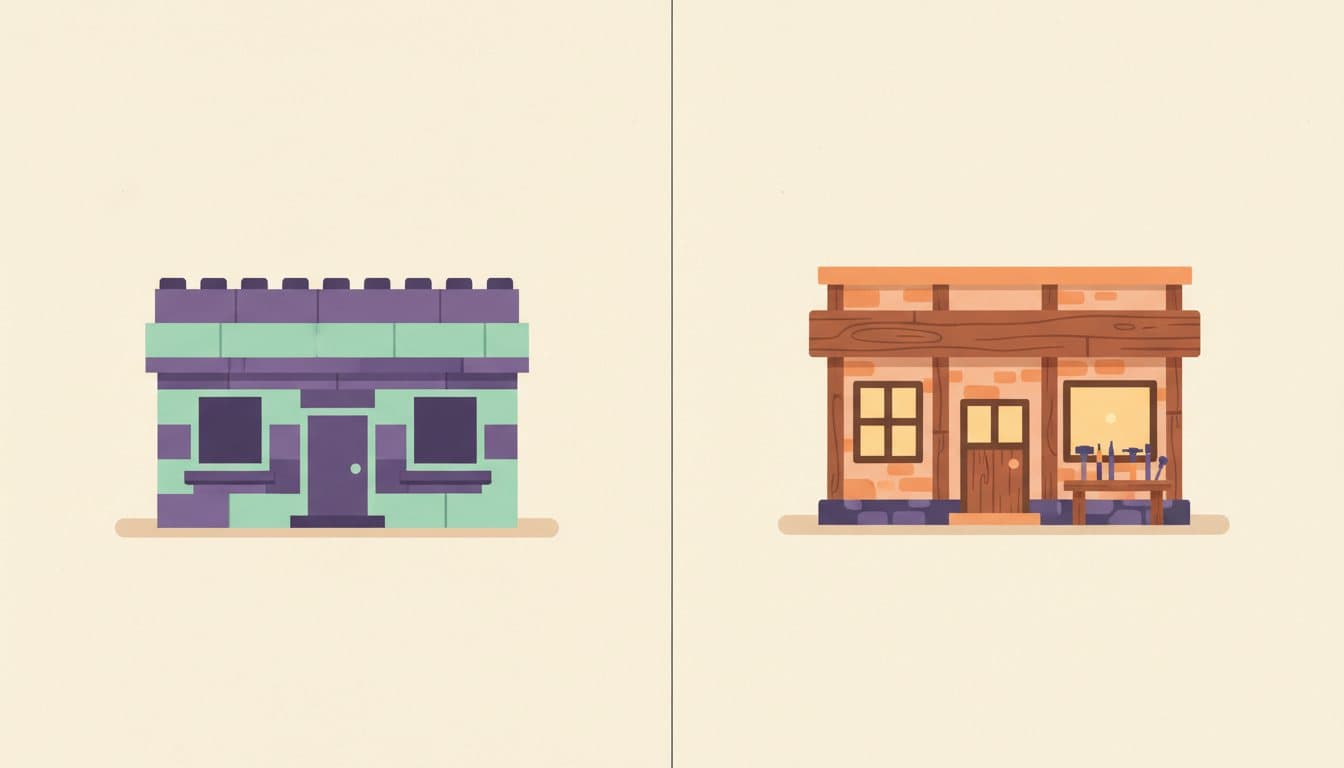
The short answer: if you need a simple site that says who you are and how to reach you, and you have more time than budget, a website builder such as Wix or Squarespace is a sensible choice. If your website has to do a specific job for the business, such as taking bookings your way, selling with your own rules, winning searches in a crowded market or growing with you for years, a custom website is usually worth the extra cost. This guide compares a custom website vs a website builder on cost, ownership, speed and search, so you can tell which side you're on.
I'm Iliya Oblakov, a software engineer. I build custom websites for small businesses, so I have an obvious bias. That's why this guide also says plainly when a builder is the better buy.
Custom website vs website builder: the quick decision table
| Your situation | Better fit |
|---|---|
| You're testing an idea and may change direction in six months | Website builder |
| You need three to five pages of information and a contact form, and you enjoy doing it yourself | Website builder |
| Most of your customers find you through search, and competitors already have strong sites | Custom website |
| You take bookings, quotes or orders with rules that builder apps don't quite fit | Custom website |
| You sell in two languages or two countries | Custom website |
| You'd rather spend your hours running the business than editing a website | Custom website with a care plan |
What a website builder is good at
A website builder is a hosted service: you pick a template, drag in your text and photos, and pay a monthly or yearly fee that covers hosting, security and the editor itself. For many small businesses that's a fair deal.
- Fast start. You can publish a decent page in a weekend.
- Low first cost. There's no build invoice, only the plan.
- No technical upkeep. The platform handles servers and security updates.
- You're in control of small changes. New opening hours or a new photo take a minute.
The trade-off is that you rent the whole thing. You get the features the platform offers, in the way the platform offers them, at the price the platform sets.
What "custom website" means here
People use "custom" for very different things, so let me be precise. In this guide a custom website is one written in code for your business: no template, no page builder and no plugin collection. The design is made for your brand, the pages are built for what your customers need to do, and you own the code.
That's different from a premium theme with your logo on it. It's also different from WordPress, which deserves its own comparison. This guide is about hosted builders versus a site built from scratch.
Is a custom website worth it? Cost over three years
The fair way to compare is total cost over the life of the site, including your own time. Builder prices change and depend on the plan, so the builder figures below are assumptions you should replace with the current price of the plan you'd actually need.
| Over three years | Website builder (example) | Custom website (my prices) |
|---|---|---|
| Build | Your own time: say 30 hours to choose a template, write, design and fix the mobile view | From £1,200 in the UK or €1,000 in Bulgaria for up to five pages, from €2,500 with bookings or a shop. Fixed in writing before work starts. |
| Running costs | Assume £30 a month for the plan, a booking or shop feature and one or two paid apps: about £1,080 | Care plan from €49 a month for hosting, updates, backups and small edits: about €1,764 |
| Changes | Your time, every time | Small edits included in the care plan, bigger changes quoted first |
| What you own at the end | Your text and images. The site itself stays on the platform. | The domain, the content and the code |
So which is cheaper? In cash terms, the builder usually is, especially for a very small site. The gap closes once you put a price on your own hours, add the paid apps a growing business tends to need, and count the enquiries a slow or generic site quietly loses. That last item is the one that decides it, and it's different for every business. A café that gets most customers from walk-ins can live happily on a builder. A guest house, a clinic or a trades business that gets most of its work from search often can't afford to.
Six differences that actually matter
1. Ownership and the cost of leaving
Hosted builders generally don't let you move your site's design and code to another host. If you outgrow the platform or its prices go up, you can take your words and photos with you, but the site itself is rebuilt somewhere else. With a custom site you own the code, so you can change hosting or hand it to another developer without starting again.
2. Speed on a phone
Builders have to support every possible layout, so each page tends to ship code for features you don't use. A custom site ships only what that page needs. Speed matters because people leave slow pages and because Google measures real-world loading speed. Don't take my word for it: run your current site through Google PageSpeed Insights on mobile and look at the field data, which comes from real visitors (a very quiet site may not have enough to show).
3. Search and AI engines
Builders cover the basics: titles, descriptions and a sitemap. Where they can get awkward is the detail: clean URLs that match how people search, proper language versions for a bilingual site, and structured data that describes your business accurately. On a custom site all of that is under your control, down to the exact HTML that search crawlers and AI engines receive. I cover the AI side in GEO for small businesses.
4. Features that fit how you actually work
This is the most common reason my clients switch. A builder's booking app works the builder's way. If your business has its own rules, such as seasonal prices, deposits, minimum stays, bundles, a quote form that calculates a price, or an enquiry that should land in your CRM, you end up stacking apps and workarounds, many with their own monthly fee. A custom site builds that logic once, in the way you already work.
Two examples from my own projects: Raya Real Estate, a property agency in Plovdiv, needed bilingual listings, natural-language search and a built-in CRM for leads. IBJ Inspired by Joanna, a handmade gifts shop, needed a live chat the owner answers from Slack and paid courses with access control. Neither fits neatly into a builder template.
5. Who does the work: you or a web developer
With a builder, you're the web team. That's fine if you enjoy it. If you don't, the site slowly falls behind: old prices, a broken form nobody noticed, a blog last updated two years ago. With a custom site and a care plan, someone else keeps it working and you send changes by email.
6. Risk
Both options carry risk, just different kinds. With a builder, the risk is the platform: price rises, changed features or a plan you're forced onto. With a custom site, the risk is the developer. Reduce it by insisting on three things: you own the domain and the code, the site uses mainstream technology another developer can pick up, and the price and scope are fixed in writing before work starts.
When I'd tell you to use a builder
- You're validating a new idea and don't know yet what the business will look like.
- Your site is an online business card: what you do, where you are, how to contact you.
- Customers mostly come from referrals or walk-ins, not from search.
- Your budget for the next year is under a few hundred pounds, and you have the time to do it well yourself.
In those cases, spend the money on good photos and clear copy instead. You can always move later.
Signs you've outgrown a builder
- You pay for three or more apps to make the site do what the business needs.
- Customers phone or message to ask things the website should answer.
- Competitors appear above you in Google for the services you actually sell.
- Your booking or order process has a step you handle by hand every single time.
- You need a second language and the builder's version of it feels bolted on.
- Your mobile PageSpeed score is in the red and you can't do much about it.
If two or more of these sound familiar, a custom site is worth pricing up.
Moving from a builder without losing your Google rankings
If you switch, the move itself is where rankings get lost, so plan it:
- List every URL on the old site, including blog posts and images that get traffic. Search Console shows which pages have impressions.
- Keep the same URLs where you can. Where you can't, set up a permanent (301 or 308) redirect from each old URL to the closest new page.
- Keep or improve the titles, headings and text of pages that already rank.
- Launch, submit the new sitemap in Google Search Console, and watch the Pages report for errors over the next few weeks.
Done this way, any dip in rankings is usually small and short-lived, and a faster, clearer site often gains ground.
What a custom website from me costs
A business website of up to five pages starts from £1,200 in the UK, or from €1,000 for businesses in Bulgaria. Booking sites and online shops start from €2,500. Most projects take 3 to 8 weeks. You get a fixed price in writing before any work starts, the site launches on your own domain, and you own the code. After launch, a care plan from €49 a month covers hosting, updates, backups and small edits.
I work fully online with clients in the UK, the EU and the US as well as Bulgaria. Alongside client projects I work remotely for Cisco through SoftServe, so the same engineering habits (tests, reviews, careful releases) go into small-business sites too. See website development: prices, process and projects.
Frequently asked questions
Is a custom website better for SEO than Wix or Squarespace?
Not automatically. A builder site with great content can outrank a badly made custom one. What a custom site gives you is control: speed, clean URLs, correct language versions and accurate structured data. On a competitive search, that control is often the difference.
Can I edit a custom website myself?
Yes, if you want to. I add a simple admin panel for the things you change often, such as prices, listings, opening hours or blog posts. For changes you make twice a year, it's usually quicker to send them over; small edits are included in the care plan.
Who owns a custom website?
You should: the domain, the content and the code. Make sure that's written into the contract. With me it is, and if we ever stop working together you keep everything.
How long does a custom website take?
About 3 weeks for a simple site, 5 weeks for a bilingual site with a blog, and 7 to 8 weeks for a site with bookings or a shop. You get a plan with a date for each step before work starts.
Can I start on a builder and move to custom later?
Yes, and it's often the smart order: prove the business first, then invest in the site. Keep a list of your URLs from day one and the move will be painless.
Not sure which side you're on? Send me your current site, or a few lines about your business, and I'll tell you honestly whether a builder will do. If custom makes sense, you'll get a fixed quote within 24 hours. Get in touch.